FREQUENTLY ASKED QUESTIONS
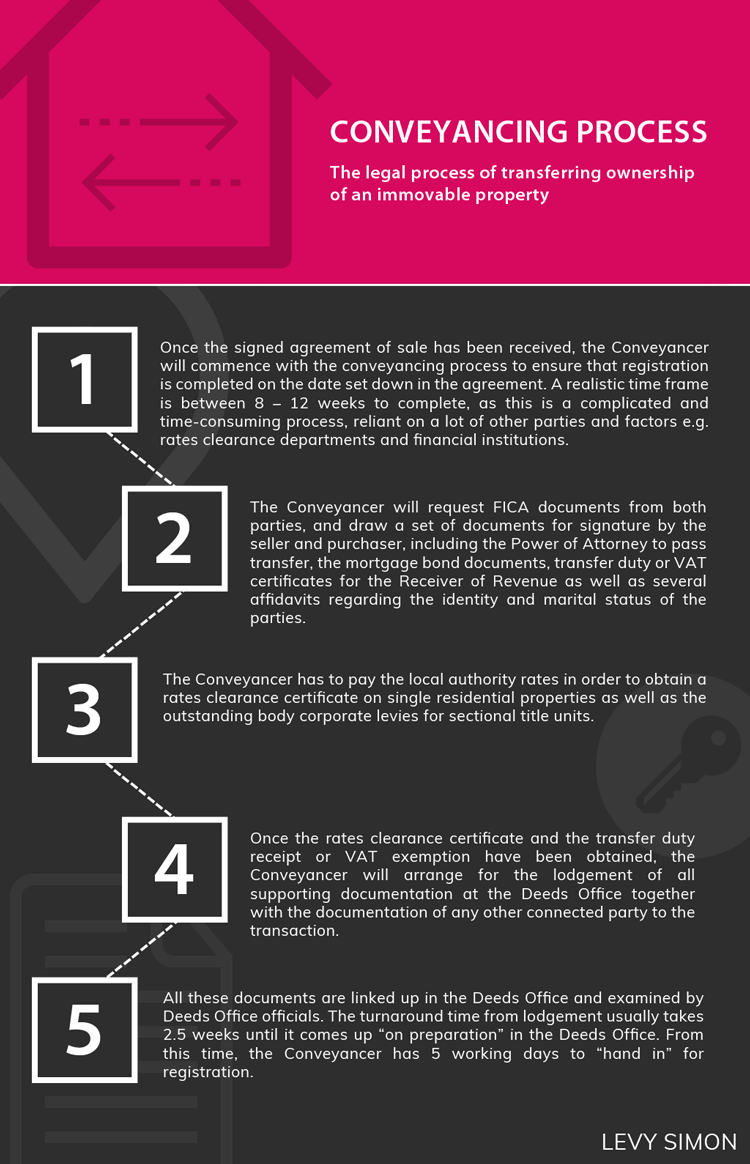
Conveyancing is the legal process of obtaining ownership of immovable property as well as the registration of mortgage bonds and other rights to immovable property. It involves the transfer process that begins on signature of the agreement of sale until the payment of the purchase price and registration of a title deed of the property into the name of the purchaser at a Deeds office in South Africa.
A Conveyancer is an attorney specially trained, and admitted by the High Court of South Africa to attend to the registration and transfer of the various property transactions. South African law requires that only a qualified Conveyancer may attend to the transfer of a property.
The Seller holds the right to appoint the Conveyancer to attend to the transfer of his/her property although the purchaser has to pay the conveyancer’s fees as well as other transfer costs. If a mortgage bond is used to finance the purchase, the bank appoint a Conveyancer, usually appointed to the Bank’s panel of approved conveyancing attorneys, to attend to the registration thereof simultaneously with the transfer of the property.
Immovable property is usually purchased by way of a written offer to purchase, signed by the purchaser, which document becomes a final and binding deed of sale upon acceptance thereof by the seller by virtue of his signature. No verbal agreement for the sale of fixed property or any verbal amendment thereof is binding on any party.
There are 10 Deeds Registries in South Africa.
The Deeds Office is the public office that holds the records of all property ownership and related property transactions. During their examination the Deeds Office examiners will ensure that there are no legal impediments against the proposed transfer.
In most instances the purchaser will have to pay transfer duty on a property transaction at the following rate:
Value / TD Payable
R0 – R900,000 / 0%
R900 001 – R1 250 000 / 3% of property value above R900 000
R1 250 001 – R1 750 000 / R10 500 + 6% of value above R1 250 000
R1 750 001 – R2 250 000 / R40 500 + 8% of value above R1 750 000
R2 250 001 – R10 000 000 / R80 500 + 11% of value above R2 250 000
R10 000 000 / R933 000 + 13% of value above R10 000 000
Please refer to our Transfer Duty Calculator on our webpage for an automatic calculation.
This applies to natural and juristic entities and in certain circumstances an exemption from transfer duty is applicable.
If the Seller is a registered vendor in respect of Value Added Tax (VAT) for the purpose of selling immovable property, VAT will be payable by the seller to the value of 15% on the purchase price. The amount of the VAT is usually included in the purchase price and the Seller will pay the amount over to the Receiver of Revenue from the proceeds of the sale against registration of transfer. Where the agreement of sale is silent on whether VAT is included or excluded, it is deemed to be included as part of the purchase price. The purchaser would be exempt from transfer duty if VAT is payable on a transaction.
A transfer cannot be completed without obtaining a rates clearance certificate that must be issued by the local authority. Such clearance certificate needs to be lodged with the documents at the Deeds Office. The purchaser should budget to pay the pro rata rates and taxes to the Conveyancer prior to transfer.
The Conveyancer’s fee is based on the guidelines prescribed by the Law Society. The guideline fee structure provides for a sliding scale based on the purchase price (transfers) and the mortgage bond amount (bond registrations), or a recommended tariff for other work. The tariff is only a guideline and the client is entitled to negotiate fees with the Conveyancer.